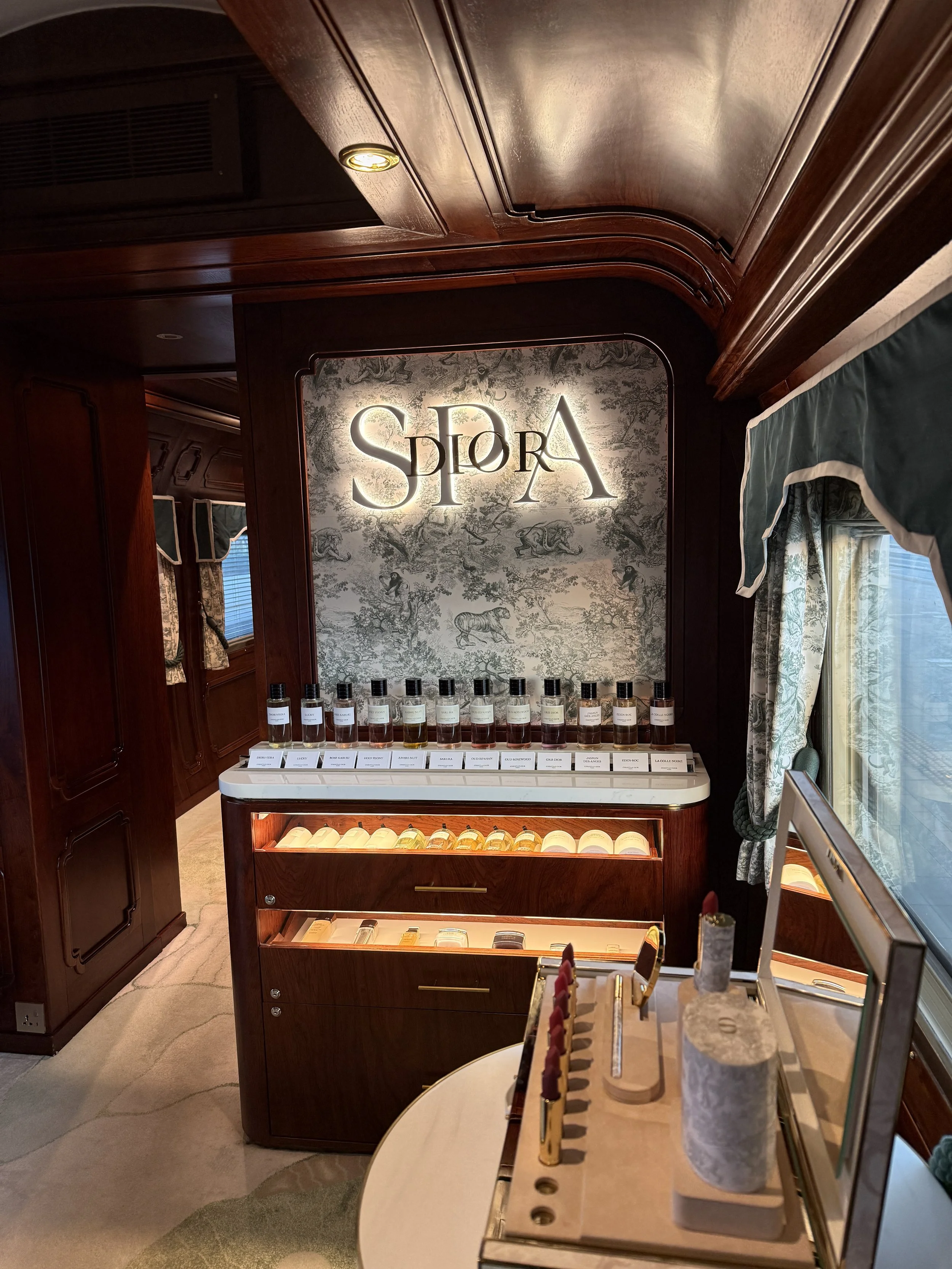
The Eastern Oriental Express is an adventure that is as unique and intriguing as the guests you will meet along the way.
The Eastern & Oriental Express is one of those journeys that carries a reputation long before departure. Images, expectations, and assumptions tend to precede it. Yet the reality of the experience reveals itself not through grand gestures, but through something far more persuasive — the quiet precision and ease with which the journey unfolds from the very beginning.
The experience began on a Sunday afternoon with a private transfer arranged by Belmond. Being collected directly from the hotel immediately altered the psychology of departure. There were no logistical puzzles to navigate, no hurried transitions between checkpoints. Upon arrival at the station, luggage was received and discreetly tagged with quiet efficiency, allowing the boarding process to feel composed and entirely free of friction. Stepping into the cabin offered the first tangible reminder that rail travel operates by a different spatial logic. The design is undeniably compact, a reality that can initially register with surprising force. Shortly after we had settled in, our butler Navin stopped by to introduce himself. In those first moments, he perceptively recognized a degree of unease from my husband, who was quietly assessing the dimensions of the room. Navin handled the situation with remarkable ease. With calm assurance, he explained the functional rhythm of the cabin — how the space would evolve throughout the day, how he would assist in keeping everything organized, and how the room’s layout was designed to remain both comfortable and efficient over multiple days. The interaction was brief yet quietly transformative. What might have lingered as hesitation instead dissolved into reassurance. True to his word, Navin maintained this sense of order and fluidity throughout the journey. Each day the cabin felt refreshed, thoughtfully arranged, and never once disorganized — a subtle yet deeply important contribution to the overall comfort of the experience.
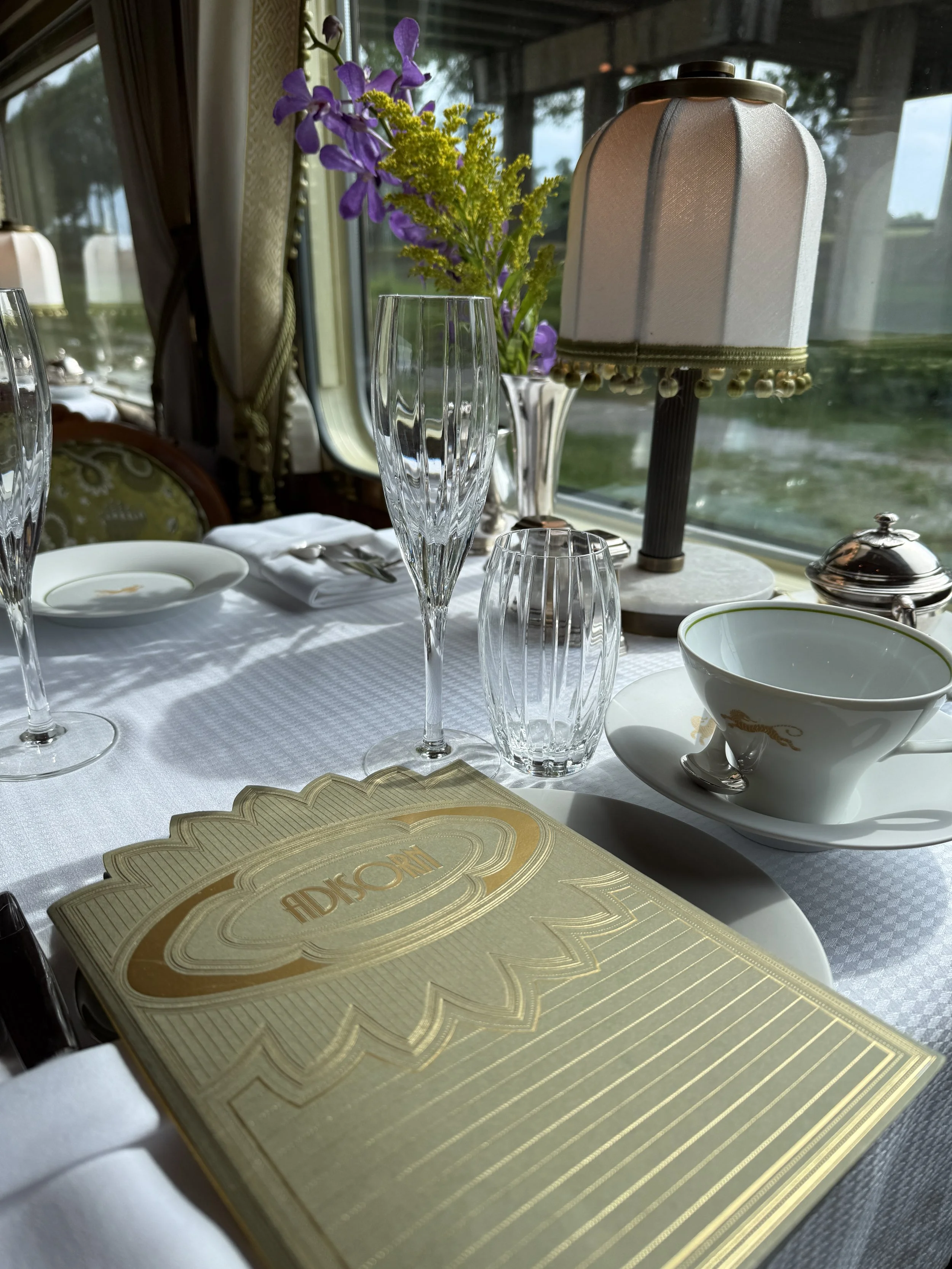
Guests were soon invited to afternoon tea in the dining car, a gentle introduction to life onboard. The experience was not defined by lively conversation but by a shared sense of arrival. Passengers, ourselves included, were still orienting — absorbing the surroundings, adjusting to the train's cadence, and quietly taking stock of the journey ahead. The atmosphere carried a distinct sense of excited anticipation.
As the train prepared for departure, announcements were made periodically, offering guidance and practical information intended to acclimate guests. What proved striking was the manner in which this was handled. The tone remained composed and reassuring, the messaging informative without feeling procedural or intrusive. Rather than disrupting the environment, these moments contributed to a growing sense of structure and calm. For those unfamiliar with extended rail journeys, the experience naturally introduces a degree of transition. The crew navigated this with warmth and attentiveness, creating an environment that felt both guided and relaxed. The dining car itself conveyed understated elegance, setting the tone for the journey while allowing guests to settle comfortably at their own pace.
Returning to the cabin afterward brought the practical realities of rail travel into clearer focus. Despite its modest dimensions, the State Cabin revealed itself to be impressively adaptable. During the day, the room functions as a sitting area, with a couch and chair arranged around a modest table — a space well suited for reading, conversation, or simply watching the landscape pass by.
Only in the evening does the cabin shift its purpose. While guests are at dinner, the seating is seamlessly converted into twin beds prepared for sleeping. By the time one returns, the room has been transformed into a neatly arranged sleeping space. In the morning, the process quietly reverses, restoring the cabin to its daytime configuration.
Storage required only modest organization. Evening attire fit comfortably within the narrow hanging closet, while additional belongings were easily accommodated on overhead shelves. The bathroom followed a similarly efficient layout. Though compact, it proved highly practical, with a cabinet providing generous room for toiletries. The presence of a Dyson hairdryer, discreetly placed within the cabinet, reflected the train’s seamless blending of heritage design and contemporary convenience.
As evening settled over the journey, the bar car naturally emerged as the social center of the train. The atmosphere each night was strikingly consistent — refined, calm, and quietly engaging. A pianist provided soft accompaniment, never overwhelming the space, while guests gathered for pre-dinner cocktails and conversation. The room carried an energy that was distinctly social yet never loud or frenetic. Conversations unfolded easily, often extending well beyond a single drink. Even at its liveliest, the bar car remained composed, the balance between sociability and quiet refinement becoming one of the most enjoyable aspects of the evenings onboard.
Dinner followed at eight o’clock and unfolded at a deliberately measured pace. The multi-course menus emphasized creativity and regional influences, frequently introducing flavors outside one’s typical repertoire. The pacing allowed each meal to feel like part of the evening rather than a scheduled obligation. Afterward, many guests drifted back toward the bar car, where music and conversation extended the night.
As the train moved through Malaysia, the motion of the cars became a noticeable but entirely manageable characteristic of the experience. The tracks introduced a gentle sway, particularly perceptible at night. The movement became part of the journey’s physical texture — a quiet reminder of continuous passage through the landscape.
Mornings aboard the Eastern & Oriental Express carried their own understated pleasures. Breakfast could be taken privately or in the dining car, and the early hours quickly developed a relaxed cadence. Rising slightly ahead of the scheduled service allowed Navin to prepare the cabin for the day and reveal the tray table positioned by the window, transforming breakfast into a quiet observational ritual accompanied by uninterrupted views of the passing scenery. Large windows throughout the train preserved a continuous connection to the outside world. Dense greenery, small towns, and vast expanses of palm trees unfolded with a curious sense of calm. Even as the train covered considerable distance, the landscape appeared to move with surprising gentleness — a perceptual quality unique to rail travel.
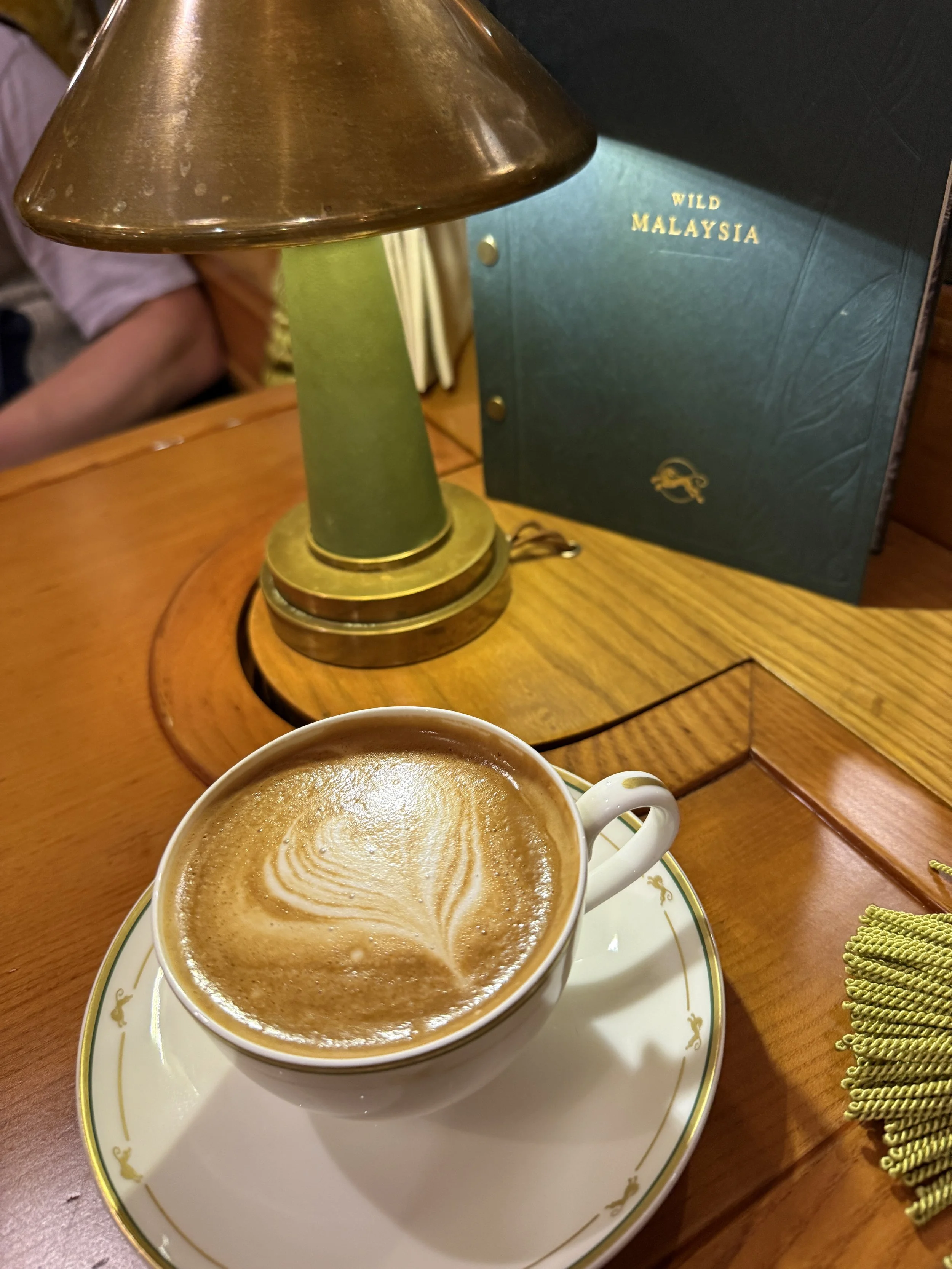
One of the most memorable moments of the journey occurred during the curated omakase-style Malaysian coffee experience hosted mid-morning in the bar car. Presented as a tasting rather than simple refreshment, the event encouraged guests to linger. Conversations overlapped, passengers exchanged impressions, and the space took on an energy distinct from the quieter rhythms of the morning.
Passengers represented a remarkably broad range of ages, yet interactions unfolded with unusual ease. It was during this gathering that I found myself engaged in an effortless and thoroughly enjoyable conversation with two young professional women traveling together. Their enthusiasm subtly challenged the notion that luxury rail journeys appeal primarily to nostalgia.
Shared activities throughout the journey further fostered connection among guests. During one such excursion, we shared a car with an older gentleman in his eighties named Robert. What began as casual exchange evolved into a deeply engaging conversation about the travels he had undertaken over the course of his life. His reflections and stories offered not only fascination but genuine inspiration for my husband and me, both devoted travelers. By the conclusion of the trip, email addresses and phone numbers had been exchanged with numerous passengers — a reflection of the train’s relaxed and welcoming social atmosphere.
Excursions integrated seamlessly into the journey’s rhythm. Transitions between train and off-train experiences felt carefully managed and notably free of strain. Among the highlights was our Penang excursion, beginning with a visit to a local market focused on Malaysian and Indian spices before continuing to the Eythrope Hotel for a cooking experience overlooking the city and water. The progression of the day felt fluid and thoughtfully paced.
Service throughout the journey consistently reinforced the atmosphere of ease. Navin was attentive, composed, and highly effective in managing the daily flow of cabin life. This warmth and professionalism extended across the broader staff, whose demeanor remained approachable and accommodating.
The arrival back in Singapore unfolded gently rather than abruptly. Customs formalities were handled efficiently, and the journey concluded with the same composure that had defined its beginning.
Perhaps the most persistent misconception surrounding luxury rail journeys concerns the type of traveler they suit. There is a tendency to assume that such experiences appeal only to a narrow audience, yet the reality feels far more inclusive. Despite my husband’s well-known preference for order and generous surroundings, any initial concern dissolved with surprising speed. The experience ultimately reveals itself not as a substitute for expansive hotel luxury, but as something entirely different — a journey defined by movement, curiosity, social exchange, and the uniquely attentive hospitality cultivated onboard. For many, it is precisely this shift in perspective that becomes the most memorable aspect of the voyage.
Train voyage - February 23, 2026